Advanced Driver Assistance Systems (ADAS) have transitioned from luxury car options into standard safety equipment across nearly every major auto manufacturer. From entry-level sedans to heavy-duty pickup trucks, modern vehicles rely on forward-facing optical cameras to power crucial safety features like automatic emergency braking, lane keeping assistance, adaptive cruise control, and blind-spot monitoring. However, when your vehicle undergoes a windshield replacement, these sensitive camera systems require precise recalibration to function correctly.
Why Every Auto Manufacturer Requires ADAS Recalibration
The forward-facing ADAS camera is mounted directly to the upper inside section of your windshield, looking out through the glass to read lane lines, traffic signs, and surrounding vehicles continuously. When a damaged windshield is removed, the camera bracket is unmounted and later reattached to the new replacement glass assembly.
Even if the camera is positioned within a fraction of a millimeter of its factory location, subtle changes in glass pitch, angle, or optical thickness distort the camera’s visual field of view. A camera misaligned by even one degree can miscalculate distance measurements on the road by several feet, leading to delayed brake warnings or false steering corrections.
Make-by-Make Calibration Requirements Overview
Auto manufacturers employ different engineering strategies for their driver safety suites, resulting in varying recalibration requirements after glass service:
- Toyota & Lexus (Safety Sense): Primarily utilizes a combination of static target board calibration and dynamic road testing to align its forward camera and radar units.
- Honda & Acura (Honda Sensing): Requires precise static target alignment set at specific heights and distances, followed by diagnostic software confirmation.
- Subaru (EyeSight): Features a dual-camera stereo system mounted behind the glass. Subaru mandates strictly static dual-target calibration using specialized alignment fixtures.
- Ford & Lincoln (Co-Pilot360): Frequently utilizes dynamic recalibration, requiring a continuous test drive on marked roads at specified speeds to auto-calibrate visual sensors.
- GM, Chevrolet & GMC (Super Cruise / Safety Assist): Employs both static target setups and dynamic road driving depending on model year and camera options.
Static vs. Dynamic Recalibration Explained
Understanding how your specific vehicle gets calibrated helps you know what to expect during your service appointment:
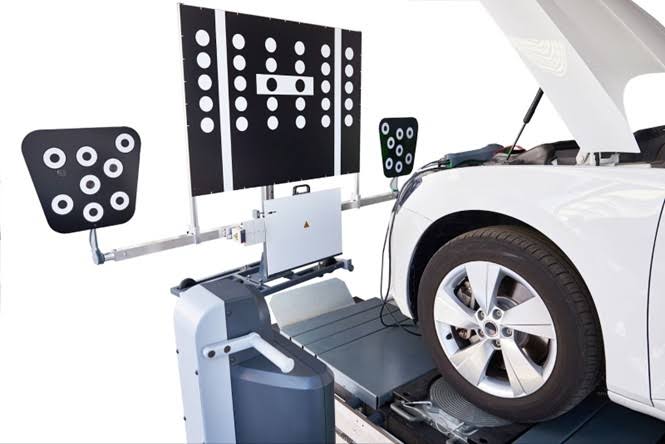
Static Calibration: Performed inside a controlled service bay. Technicians set up vehicle-specific target patterns placed at mathematically precise distances, angles, and heights in front of the vehicle. Computer diagnostic software connects to the car’s OBD-II port to align the camera’s visual sensors with the physical target boards.
Dynamic Calibration: Performed while driving the vehicle on public roads. The technician drives the car at steady speeds along roads with clear lane markings, allowing the internal software to map surrounding landmarks and self-calibrate optical camera angles.
Consequences of Skipping Windshield Camera Calibration
Skipping camera calibration after replacing your windshield compromises your vehicle’s entire safety network. Common failure modes of uncalibrated camera systems include:
- Inaccurate lane departure warnings that fail to alert you when drifting over lane boundaries.
- False automatic emergency braking triggers that cause unexpected deceleration in heavy traffic.
- Adaptive cruise control following target vehicles too closely at highway speeds.
- Dashboard warning lights and stored diagnostic trouble codes (DTCs).
Finding Certified Camera Calibration Specialists
Because ADAS recalibration demands specialized diagnostic equipment, target fixtures, and trained technicians, not all general auto repair shops are equipped for the job. When replacing your windshield, choose a dedicated provider experienced in windshield camera calibration Austin TX to ensure your safety features are restored to factory standards before you hit the road.
The Certification and Documentation Process
After your calibration service is complete, a professional shop provides a detailed post-scan diagnostic report and official calibration certificate. This documentation confirms that all camera modules communicate cleanly with your vehicle’s computer and meets manufacturer safety guidelines. Keeping this record protects your vehicle resale value and satisfies insurance compliance requirements.